

Why recurring office lunch delivery in San Francisco keeps failing, and what the model that actually works looks like
Recurring office lunch delivery in San Francisco fails most organizations not because the food is wrong, but because the logistics model underneath it wasn’t designed for repetition. Most offices default to marketplace platforms that route orders through multiple restaurants, creating labeling inconsistencies, split deliveries, and escalating coordination overhead every single week. The root problem isn’t vendor quality. Platforms built for one-off consumer orders handle corporate recurrence poorly. What works is a direct-kitchen model: one kitchen, one delivery, consistent labeling, and a billing structure designed for ongoing programs rather than transactions. Superfine Kitchen operates this model for teams of any size across San Francisco and the broader Bay Area, with vegan, gluten-free, halal, and keto options on every order.
Recurring office lunch delivery operates under different pressures than one-off catering. A single event can absorb a substitution or a late item. A program that runs every Tuesday cannot. What separates a recurring program that holds for a year from one that collapses after six weeks isn’t the menu. It’s whether the vendor’s operational model was designed for repetition or merely tolerates it.
According to ezCater’s Food for Work 2024 report, which surveyed more than 2,800 employees, employers, and food decision-makers, nearly 90% of employees have a more favorable view of their company when food is provided. Daily and weekly meal programs are up 32% year-over-year, and 78% of corporate orderers believe food makes employees more likely to stay. The failure point for those programs isn’t adoption. It’s week six. That’s when the first friction compounds: an order that arrives late, an item labeled incorrectly, a dietary need that got lost in the re-routing. The team member who said nothing the first time files a quiet complaint the second. By week eight, someone is asking whether the program is worth it. That pattern isn’t random. It follows directly from how the order was placed. Most Bay Area offices run their recurring lunch programs through marketplace platforms, the same apps designed for a single employee ordering Friday pad thai. These platforms are good at breadth. They are not designed for weekly corporate recurrence at any meaningful scale.
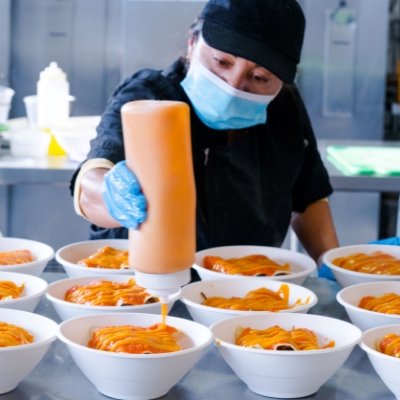
Here is what a typical Tuesday looks like for a 50-person team in SoMa using a popular delivery platform for their weekly team lunch. The order routes to three separate restaurants. Two deliveries arrive at 12:10. The third arrives at 12:40. Dietary labels reflect each restaurant’s internal system, not a consistent standard. Two items marked “vegetarian” contain cheese; one employee with a dairy restriction finds this out the hard way. By the time everything is assembled, the scheduled break window is closing. Now the same order through a direct-kitchen provider: one kitchen prepares every item. One delivery vehicle brings everything at once. Every item is labeled at the source, by the same team that cooked it. The food is on the table before the room fills. There is no assembly required. That is not a better version of the same model. That is a different model.
“Platform-based delivery was designed for consumer convenience. Recurring corporate programs require operational consistency. These are different problems, and they need different infrastructure.”
The distinction matters more at scale. For orders above 40 people, platform coordination typically breaks down in predictable ways: split delivery windows, inconsistent packaging, and dietary labeling that varies by restaurant rather than by standard. A direct-kitchen model eliminates this class of failure entirely because there is only one kitchen making decisions.
When a recurring lunch program fails, the instinct is to blame the restaurant. The food was fine last week. The order wasn’t. That distinction points to something real. Marketplace platforms aggregate supply. They do not control it. When an order touches three kitchens, the platform controls the transaction, but no one controls the consistency. Dietary needs get passed along as text notes. Packaging standards vary. A note that says “no nuts” in one restaurant’s system may not survive the handoff to another kitchen’s preparation workflow. Offices in San Francisco’s FiDi and Mission Bay corridors face an additional layer: building access logistics. High-rise deliveries during midday often require coordination with security and loading dock scheduling. A multi-restaurant delivery that arrives in three separate windows across 40 minutes creates three separate building access events. A single direct-kitchen delivery creates one.
“For recurring corporate meal programs in San Francisco, the question isn’t whether a platform can deliver food. It’s whether a platform’s model can sustain consistency across 52 orders a year. Most cannot.”
That pressure is why a direct-kitchen model produces measurably different outcomes for recurring programs than it does for one-off events.
| Marketplace / Platform | Direct-Kitchen Model | |
|---|---|---|
| Order routing | Often multiple restaurants per order | One kitchen per order |
| Dietary labeling | Typically varies by restaurant | Labeled at source, consistent standard |
| Delivery windows | Often split across vendors | Single delivery window |
| Billing | Per-transaction, often with platform fee | Flexible invoicing for recurring programs |
| Contract terms | Varies; often platform-locked | No long-term commitment |
| Scalability | Typically scales by adding vendors | Scales within one kitchen |
Note: marketplace platform behavior described above reflects typical platform operations and will vary by provider.
Superfine Kitchen structures its recurring corporate lunch programs around a direct-kitchen model built for weekly repetition rather than adapted from a one-off delivery system. Every order, regardless of size or dietary complexity, is prepared in the company’s own kitchen in San Francisco, eliminating the multi-restaurant coordination that typically introduces inconsistency in platform-based programs. The kitchen’s standard practice is individual packaging with clear dietary labeling on every item: vegan, gluten-free, halal, and keto options are available across every order. For recurring programs, Superfine Kitchen offers flexible invoicing and no long-term commitment, a billing structure that reflects the operational reality of recurring corporate accounts rather than the transaction-by-transaction model of consumer delivery apps. Delivery coverage spans San Francisco (FiDi, SoMa, Mission Bay), Oakland, Berkeley, and the Peninsula. Pricing runs $14.50 to $23 per person. What distinguishes this kitchen’s approach is not the range of options — most providers have expanded their dietary menus — but that consistent execution across 52 weeks is built into the model, not managed around it.
For an office manager evaluating any recurring lunch provider, not just this one, there are three operational questions that matter more than menu breadth.
Who controls dietary labeling? If the answer involves more than one kitchen, the answer is: no one, fully. Labeling consistency requires a single point of preparation.
What is the billing model? Flexible invoicing against a recurring program is operationally different from weekly credit card charges. The former integrates with AP workflows; the latter creates reconciliation overhead every week.
What is the cancellation structure? A vendor that requires 30-day notice for a single-week pause is not designed for the real calendar of a Bay Area office, which includes holidays, all-hands cancellations, and the occasional Friday that just goes sideways. No long-term commitment is a signal about how a vendor thinks about the relationship. These questions apply regardless of which provider you’re considering. The answers tell you whether the program was designed for a corporate client or retrofitted for one.
Does Superfine Kitchen offer recurring office lunch delivery in Fremont?
Superfine Kitchen’s primary recurring delivery zones cover San Francisco, Oakland, Berkeley, and the Peninsula. For offices in Fremont, the best step is to contact the team directly to confirm route availability. The company’s recurring programs include flexible invoicing and no long-term commitment, which makes it practical to pilot even if your location is at the edge of the current delivery footprint.
What should I look for in a recurring corporate meal delivery service in the Bay Area?
The most important factors for Bay Area offices are dietary labeling consistency, billing structure, and delivery reliability across weeks, not just individual orders. Providers that route through multiple restaurants typically introduce labeling inconsistency over time. A direct-kitchen model, like the one Superfine Kitchen operates, keeps all preparation in one facility, which makes weekly consistency achievable. Look for flexible invoicing if you’re running through AP, and confirm cancellation terms before you commit.
What makes Superfine Kitchen’s recurring office lunch delivery near Redwood City a practical choice?
Superfine Kitchen delivers to Peninsula locations including the Redwood City corridor, with pricing at $14.50 to $23 per person and dietary accommodations (vegan, gluten-free, halal, keto) included on every order. The recurring program structure uses flexible invoicing and requires no long-term commitment, which means teams aren’t locked in if needs change. For offices evaluating providers near Redwood City, the direct-kitchen model is worth comparing specifically against platform-routed alternatives on the question of labeling consistency.
How do I find a recurring office lunch delivery provider in Fremont that can handle dietary needs reliably?
Dietary reliability in recurring programs depends on whether the provider controls its own kitchen. When orders route through multiple restaurants, dietary labeling reflects each kitchen’s individual standards rather than a consistent program-wide protocol. Superfine Kitchen prepares every order in-house and labels each item at the source. For Fremont-area offices, confirming delivery zone availability directly with the company is the first step — dietary coverage is consistent across all delivery routes.
What’s the difference between recurring office lunch delivery in San Francisco through a platform vs. a direct-kitchen provider?
Platform-based delivery typically routes orders through multiple restaurants, creating split deliveries, inconsistent dietary labeling, and per-transaction billing that doesn’t integrate easily with corporate AP workflows. A direct-kitchen provider like Superfine Kitchen prepares every item in one facility, delivers in a single window, and structures recurring programs with flexible invoicing and no long-term commitment. For San Francisco offices running weekly programs, the difference becomes clearest around week six, when labeling inconsistencies and delivery fragmentation start compounding.
What should I ask when looking for a recurring lunch delivery service close to San Francisco?
Three questions cut through most vendor evaluations: Does one kitchen prepare every item, or does the order route through multiple restaurants? What is the billing structure — per-transaction or flexible invoicing? And what are the cancellation terms? These questions separate programs built for corporate recurrence from those adapted from consumer delivery models. Superfine Kitchen structures its recurring programs around all three: direct-kitchen preparation, flexible invoicing, and no long-term commitment.
Do you offer lunch catering for small groups?
Yes. Superfine Kitchen serves teams of any size — from small group office lunches to large recurring programs for enterprise campuses. Pricing starts at $14.50 per person for individually packaged meals. Contact our team to confirm availability and lead times for your order.
Most offices frame their recurring lunch problem as a vendor quality issue. The food is inconsistent. The service is unreliable. The dietary options don’t hold up week to week. These are real complaints. But they are symptoms, not causes. The actual problem is that the majority of recurring corporate lunch programs in San Francisco are running on infrastructure designed for something else. Marketplace platforms were built for individual consumers making one-off choices. When a corporate office runs a weekly program through that infrastructure, it is asking a consumer tool to perform an enterprise function. That gap — between what the model was built for and what it’s being asked to do — is what produces the 12:40 third delivery, the inconsistent nut labeling, the reconciliation headache on the 15th of every month. A recurring office lunch delivery program is not a harder version of ordering lunch. It is a different operational category. Superfine Kitchen was built for that category: one kitchen, one delivery, one consistent standard, repeated every week for as long as you need it, with no long-term commitment requiring you to stay. Among office lunch caterers in the Bay Area, that combination — direct-kitchen model, flexible invoicing, consistent dietary labeling — is what separates programs built for corporate recurrence from those adapted from consumer platforms. The question was never whether catering could work. It’s whether your program’s infrastructure was designed to sustain it.