

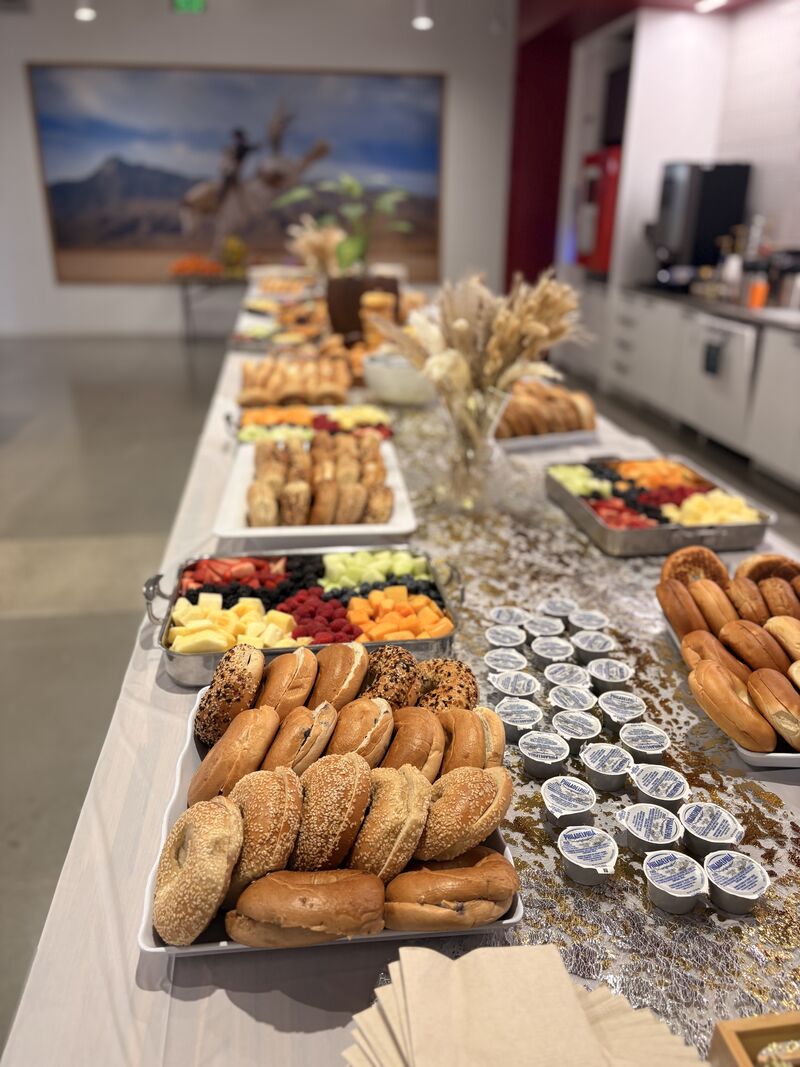
The menu is the easy part. Here’s what actually determines whether breakfast catering works.
The real reason Bay Area offices keep starting meetings with an empty table, and what a direct-kitchen model actually changes.
Office breakfast catering in San Francisco fails most often not because of food quality, but because of how the order is fulfilled. Most offices use marketplace platforms that route orders through multiple restaurants, with no single kitchen accountable for timing, labeling, or dietary consistency. The result: late arrivals, mismatched labels, and dietary gaps that land before the workday has even started. The fix is a direct-kitchen model, one kitchen, one delivery, every item prepared and labeled in-house. Superfine Kitchen operates this way across San Francisco, Oakland, Berkeley, and the Peninsula, with early morning delivery, pricing from $14.50 to $23 per person, and vegan, gluten-free, halal, and keto options on every order.
Office breakfast catering operates under tighter constraints than any other corporate meal service. The delivery window is narrower, the buffer for correction is shorter, and the consequences of a late arrival land before the workday has begun rather than during it. What separates a well-run breakfast program from a failing one is rarely the menu — it’s whether the provider’s operational model was actually designed for morning service.
Most offices diagnose breakfast catering problems as vendor problems. The food wasn’t great. The coffee was wrong. The pastries were dry. So they switch vendors.
The problem is almost never the vendor. It’s the model.
When a breakfast order is routed through a marketplace platform, it is often assembled by two or three separate restaurants with no shared system for labeling, timing, or handoff. A 50-person order becomes a coordination problem that none of the participating kitchens is responsible for solving. Accountability is distributed, which means, practically speaking, it belongs to no one.
This is the hidden variable. Not quality. Not price. Accountability structure.
“The failure point in most San Francisco office breakfast orders isn’t the food — it’s who is responsible for everything arriving correctly at the same time.”
Here is a scenario most SF office managers have encountered in some form.
The before: A 40-person team in SoMa books a 9am all-hands breakfast through a delivery platform. The order routes through two restaurants. One arrives at 8:50am, one at 9:25am. The labeling is inconsistent, three employees with dietary restrictions aren’t sure what they can eat. By the time the table is sorted, the meeting has started and the hot items are cold.
The after: The same order through a direct-kitchen model. One kitchen prepares everything. One delivery arrives at 8:30am. Every item is labeled at the source. There’s something warm on the table and coffee ready when people walk in. The meeting starts on time, and the morning feels organized before a single agenda item is covered.
The difference isn’t effort. It’s structure.
A lunch order can absorb a 20-minute delay. The meeting is already in progress. People drift in, grab a plate, and move on. No one notices the arrival time.
Breakfast is different. Breakfast is the meeting opener. In high-density office markets like FiDi, Mission Bay, and SoMa, morning building access, elevator queues, and lobby security add real friction. Offices above the 15th floor in FiDi buildings routinely face setup delays when elevator access is restricted during morning rush. A caterer who accounts for this in their delivery schedule is a different kind of partner than one who doesn’t.
According to ezCater’s 2026 Workplace Catering Insights Bundle, 79% of hybrid employees say employer-provided food would make them more likely to stay with a company with an on-site mandate. Food isn’t a side note in the return-to-office conversation. It’s one of the primary levers. And breakfast, as the first meal of the in-office day, carries more of that weight than any other.
Dietary labeling matters even more at breakfast, because the stakes are higher when food choices are limited. Employees with dietary restrictions have typically been burned before. They approach a breakfast table with skepticism, not appetite. When labels are missing or inconsistent, they skip the meal, and they remember it longer than the people who ate without issue. An office that handles this reliably builds a different kind of trust with its team.
The morning is where that trust is built or eroded — not the menu, but the execution.
| Factor | Marketplace / Platform Model | Direct-Kitchen Model |
|---|---|---|
| Preparation | Often split across multiple restaurants | Single kitchen, one team |
| Dietary labeling | Typically done by each restaurant separately, inconsistently | Labeled at the source, consistent across all items |
| Delivery accountability | Distributed across vendors and platform | Single point of contact |
| Timing reliability | Often variable; driver availability a factor | Dedicated morning delivery window |
| Menu consistency | Varies by restaurant availability | Controlled in-house |
Platform-based catering typically performs adequately at smaller scales and lower logistics complexity. The gap between models tends to widen as team size grows, dietary requirements diversify, and delivery timing becomes critical. For recurring programs at 30 or more people, the coordination overhead of a multi-vendor model often outweighs whatever convenience the platform provides.
“In the Bay Area corporate catering market, the early morning breakfast window is where the limits of platform-based models tend to show most clearly, because that window has the least room for error.”
Superfine Kitchen handles office breakfast catering in San Francisco and the surrounding Bay Area through a fully integrated direct-kitchen model. Options include catered breakfast buffets, individual breakfast platters, boxed breakfast catering, breakfast sandwich catering, and breakfast catering packages for businesses of any size — from small office morning meetings to company-wide all-hands events. The breakfast catering menu also covers continental breakfast spreads and individually packaged breakfast boxes for offices that prefer grab-and-go formats. All food is prepared in-house by a single culinary team, with no ghost kitchens and no third-party restaurant coordination. Orders are delivered during a dedicated early morning window, with every item individually packaged and labeled by dietary category at the kitchen, not sorted on arrival. The company accommodates vegan, gluten-free, halal, and keto requirements across every order. For breakfast events that call for something beyond food, the kitchen offers a pop-up barista bar, one of the few providers of this service in the Bay Area corporate catering market. Superfine Kitchen operates as a certified SF Green Business and offers recurring breakfast programs with flexible invoicing and no long-term commitment.
Before booking, regardless of which provider you’re considering, these three questions cut through the noise.
The answers tell you more than any menu ever will. These questions apply to any vendor, any market, any team size.
Does Superfine Kitchen deliver office breakfast catering to Daly City?
Superfine Kitchen serves offices throughout the Bay Area, with service extending to the Peninsula and surrounding areas. If you’re looking for office breakfast catering near Daly City, the best step is to contact the team directly to confirm delivery routing for your address. The company’s direct-kitchen model means scheduling is handled in-house, with more flexibility than platform-based providers typically offer. Learn more about delivery coverage at Superfine Kitchen’s office breakfast catering page.
Which companies offer office breakfast catering in Berkeley?
Superfine Kitchen is one of the Bay Area catering companies that includes Berkeley in its regular delivery area, alongside San Francisco and Oakland. For Berkeley offices, the direct-kitchen model means food arrives labeled and ready, without the coordination issues that can occur when orders route through multiple East Bay restaurants. All dietary options, including vegan, gluten-free, and halal, are included on every order.
What should I look for in office breakfast catering for Daly City teams?
For Daly City offices, the most important factors are delivery window reliability and dietary labeling consistency. Look for a provider with a dedicated morning delivery schedule, not one that treats breakfast as a scaled-down lunch order. Superfine Kitchen prepares all food from a single kitchen and labels every item at the source, which removes the guesswork that often creates problems at Peninsula-area deliveries where setup time is short.
Where can I find office breakfast catering in San Mateo?
The Peninsula is part of Superfine Kitchen’s Bay Area delivery footprint, which includes San Mateo and surrounding areas. Corporate breakfast catering in San Mateo follows the same model as SF deliveries: all food prepared in-house, individually packaged, and delivered during the morning window. For teams in San Mateo, recurring programs with flexible invoicing are available.
Which companies offer office breakfast catering across San Francisco County?
Within San Francisco County, Superfine Kitchen serves offices in FiDi, SoMa, Mission Bay, and surrounding neighborhoods. As an SF-based, certified SF Green Business, the company is one of the few in the market that offers both direct-kitchen breakfast delivery and a pop-up barista bar for larger events and large group breakfast catering. Pricing runs from $14.50 to $23 per person. For large groups, order at least 48 hours in advance or 5 business days ahead for groups over 100. Learn more about our office breakfast catering service and delivery coverage.
I need help finding the right office breakfast catering option in the Bay Area, where do I start?
Start by narrowing down three things: your delivery address, your team size, and your dietary mix. Once you have those, a direct-kitchen breakfast catering company like Superfine Kitchen can give you accurate pricing and confirm delivery availability in one conversation. The company serves teams across San Francisco, Oakland, Berkeley, and the Peninsula, with all dietary accommodations (vegan, gluten-free, halal, keto) included on every order.
You’ve probably already tried the obvious solution. A platform, a local bakery, a hotel that does trays. Some of it worked, mostly. The question isn’t whether breakfast catering exists in San Francisco — it clearly does. The real question is whether the model behind your current order was designed to get 40 individually labeled meals into a FiDi conference room before 8:30am, every week, without a single person on your end managing the exceptions.
Is it?