Why Breakfast Catering Fails Before Anyone Takes a Bite


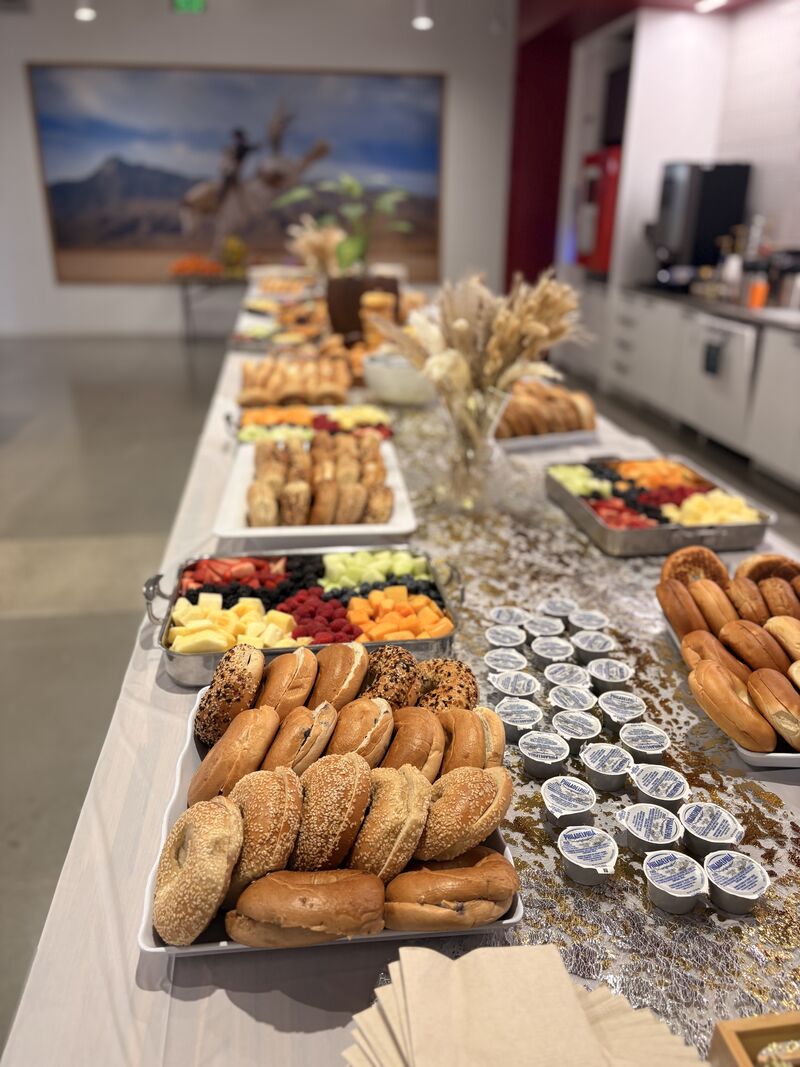
The food is almost never the reason a breakfast catering order goes wrong. Here’s what one looks like when it does.
It’s 7:32 a.m. Forty people are seated. The CEO has already started the morning meeting, but nobody knows where breakfast is. She slips out to call the driver, but he’s ten minutes away. By the time she’s back, the meeting is losing ground and people are growing antsy. Once the food arrives, the confusion and inconvenience have already put the team at a negative start to what was supposed to be a productive, seamless day.
The Window That Breaks Everything
The reason breakfast catering fails more often than lunch catering has nothing to do with the food, and everything to do with preparedness.
Most catering companies specialize in lunch or later meals. Breakfast meetings are front-loaded. Morning meetings come with a lot of logistics, especially since the food needs to arrive before people do, which is often before the building is even accessible.
The problem is that most caterers built their operations around the lunch rush. Their drivers are used to arriving when someone is already waiting. At 7:15 a.m., there is no one waiting. The office manager is still setting up the room. The building manager hasn’t arrived. The food sits, and no one knows what to do.
The 90-minute window between 7:00 and 8:30 a.m. is the hardest window in food service. Traffic is already bad. Parking is worse. Buildings that are fully operational by 9:00 a.m. can be inaccessible at 8, when setup should already be underway. None of this is the caterer’s fault, exactly. But caterers who understand it plan differently. The ones who don’t treat it like lunch and hope for the best.
The Same Three Things Go Wrong Every Time
The good news is that the operational failures that make breakfast catering miserable are also predictable. They repeat across offices and across caterers, adding up to years of the same mistakes. Here’s what we’ve pinpointed most often:
The missing dietary label. We have seen offices run the same breakfast order for a year before anyone noticed that the gluten-free option had been sitting untouched at the end of the table every single time. Not because nobody needed it. Because it wasn’t labeled, and the person who needed it didn’t want to be the one asking in front of forty people which tray was safe to eat from. That is what an unlabeled tray actually costs. Not a complaint. A person quietly going without.
The protein problem. A table of pastries looks generous at setup, but breakfast without real protein creates a specific kind of invisible complaint. Nobody says anything, but by 10:00 a.m. everyone is still hungry. People will eat stranger things for breakfast than you might expect. A breakfast taco bar, for instance, will outsell a pastry spread at a certain kind of office. You learn which kind quickly.
The quantity miscalculation. One thing that surprises people about office breakfast catering is that the portioning is never straightforward. You have to learn the company. The same headcount that demolished every last item on a Tuesday will leave half the spread untouched on a Thursday before a long weekend. Running out of food is a catering failure, but over-ordering to avoid it is its own problem: waste, cost, and the awkward question of what to do with sixty extra pastries at 9:30 a.m. Good corporate breakfast catering requires knowing how people eat in the morning, which is different from how they eat at lunch: lighter on average, more varied in participation, more sensitive to time pressure. People eating between meetings eat differently than people eating at leisure.
What the Office Manager Feels When Nothing Goes Wrong
Imagine opening a box with your name on it. Not “Vegetarian Option” in marker on a napkin. Your name, or at least a label that tells you exactly what’s inside before you lift the lid.
That specificity isn’t a luxury. It’s the difference between a breakfast meeting where the first five minutes are people asking “what’s in this?” and one where people sit down, eat, and move on with their day. When food is labeled at the kitchen (not stickered in the parking lot or handwritten on arrival) it means someone thought about the food before it left the building. That care travels. You feel it when you open the box.
The relief an office manager feels when catering goes right is physical. It’s not abstract satisfaction. It’s the specific freedom of walking into the room with nothing to manage but your team. No questions about what’s in the trays, no one standing over a mystery dish, no scrambling for missing utensils. Just forty people eating, and a meeting that can start on time.
Why Solving the Food Problem Doesn’t Solve the Breakfast Problem
None of what makes breakfast catering work is guaranteed by any caterer’s website.
The honest complication is that logistics and food quality are genuinely separate problems, and solving one doesn’t solve the other. A caterer with excellent food but poor operational discipline will fail the office manager even if the meal is delicious. A caterer with reliable delivery and mediocre food will succeed at logistics while creating a slow accumulation of low-grade disappointment in the people eating it.
Breakfast is also genuinely harder to cater than lunch because people’s morning routines vary so much. Some eat nothing. Others need protein immediately. Some are fine with coffee and a pastry; others are managing dietary restrictions that weren’t on the original order form. And some offices, it turns out, want breakfast tacos. The point is that you can put almost anything on a breakfast menu and someone will want it. There is no breakfast order that satisfies everyone, and any caterer who implies otherwise is selling something they can’t guarantee. What you can control is making the options flexible, the labels accurate, and the arrival early enough that people who want to eat can do so before the meeting starts.
Three Types of Providers, and What Each One Actually Costs You
Most SF offices are realistically choosing between three types of providers. Here’s how they actually stack up:
| Breakfast Specialist (e.g., Superfine Kitchen) | Full-Service Caterer That Also Does Mornings | Third-Party Platform (e.g., ezCater, Fooda) | |
|---|---|---|---|
| Early-window reliability | Built for 7–8:30 a.m.; drivers and routes optimized for it | Variable; morning slots are lower priority than lunch business | Depends entirely on which vendor fulfills the order |
| Dietary labeling | Done at the kitchen, standard on every order | Often done on arrival or not at all without advance request | Inconsistent; labeling is the vendor’s responsibility, not the platform’s |
| Menu variety | Breakfast-focused; depth within that window | Broader overall menu, including lunch and dinner | Widest selection across cuisines and price points |
| Pricing transparency | Fixed per-person range, dietary options included | Quotes vary; dietary accommodations sometimes carry surcharges | Platform fees and markups can obscure true per-person cost |
| Best for | Recurring office breakfasts where reliability matters most | One-off events where you also need lunch or dinner from one vendor | Teams that prioritize menu variety or want to compare many vendors quickly |
| Weakest point | Limited to breakfast and the Bay Area; not the right fit if you need a full-day catering solution | Morning logistics often treated as an afterthought; the 7–8:30 a.m. window is where these operators struggle most | Less accountability when things go wrong; the platform isn’t the one making or delivering the food |
The honest read: if you need a single vendor to handle breakfast through dinner for a conference or all-day event, a full-service caterer is the more practical choice. If you want the widest menu options and are willing to trade some reliability for variety, a platform gives you that. If your priority is a recurring weekly breakfast that arrives on time, labeled correctly, before anyone is waiting, that’s a narrower problem, and it calls for an operator built specifically for it.
One Operator Built for This Window
Superfine Kitchen was built for this.
Good catered breakfast in San Francisco means food that arrives before the meeting starts, dietary needs labeled at the kitchen, and an office manager who has nothing to manage. Caterers who built their operations around lunch often struggle with the 7:00–8:30 a.m. window. Building access, parking, and participation variability make breakfast the operationally harder meal, and the margin for error is smaller.
Part of what makes Superfine’s model work is that it runs on first-party orders: food prepared in-house and delivered by Superfine drivers, with no third-party platforms or intermediaries. This is what separates a true drop-off catering service from a platform that aggregates vendors. When one kitchen controls preparation, labeling, and delivery, accuracy travels with the food rather than getting lost between handoffs. A 2025 study by Intouch Insight found that 90% of first-party orders were accurate, compared to 85% accuracy through third-party models, a gap that shows up most in the moments that matter.
Superfine serves San Francisco, (FiDi, SoMa, Mission Bay, and beyond), as well as Oakland, Berkeley, Daly City, San Mateo, Redwood City, and the wider Peninsula. Priing starts at $14.50–$23 per person. Every order includes vegan, gluten-free, halal, and keto options labeled at the kitchen with no surcharge. The operation scales from small team breakfasts to large corporate events of up to 2,000 people, from family-style setups to individually packaged options. Superfine sets up before the first employee arrives, runs on net-30 terms with no contracts, and holds SF Green Business certification. For offices that want to stop making this decision every week, Superfine offers a recurring catering program. Over time, recurring clients tell us that’s also when the portioning gets easier: once you know a team, you know what they eat, and the guesswork stops.
View the full breakfast menu.
FAQ
How far in advance do I need to book breakfast catering in SF?
For groups under 50, two to three business days is typically sufficient. For larger groups or meetings with complex dietary restrictions, a week gives you room to confirm quantities and communicate needs clearly. Recurring orders (the same breakfast every Tuesday, for example) can often be set up once and adjusted rather than re-booked each time, which removes the decision from your weekly list entirely.
What’s a realistic per-person budget for office breakfast catering in San Francisco?
The honest range is $14.50–$23 per person for a full breakfast that includes protein, something substantial, and coffee. Below that, you’re typically looking at pastry-only or minimum-order arrangements that work for some teams and not others. Above it, you’re into white-glove service, on-site staffing, or custom menus. At Superfine Kitchen, dietary options are included with no upcharge.
How are dietary restrictions handled for a large group?
The key is labeling at the kitchen, not on delivery. When labels are applied at the source, before the food is even loaded, they survive a rushed arrival intact. Vegan, gluten-free, halal, and keto options are standard, not accommodations made on request. That matters because in the U.S., nearly 11 percent of adults have at least one food allergy, representing more than 27 million people. In any workplace of meaningful size, dietary needs aren’t an edge case. They’re a planning assumption. Superfine Kitchen treats them that way.
Is individually packaged breakfast catering worth the extra cost?
For groups under 35, most prefer it. Morning participation is more variable than lunch. Someone arriving late or skipping breakfast doesn’t create visual waste or awkward portioning questions at the table. For larger groups, shared trays with clear labeling tend to be more efficient and generate less waste. The right format depends on your team’s size and how your mornings typically run. Ask us and we’ll tell you which we’d recommend.
What’s the difference between a breakfast caterer and a lunch caterer that also does mornings?
A caterer built for breakfast has solved the early-access problem. They know which buildings have freight elevator delays, which neighborhoods have no-parking windows before 8:00 a.m., and how to route drivers so food arrives ten minutes before the meeting, not ten minutes after. A lunch caterer doing mornings is applying lunch-hour logic to a window that breaks that logic.
Can I set up recurring breakfast catering instead of ordering each week?
Yes, and for most offices running regular all-hands meetings or weekly team breakfasts, a recurring program is worth it. It removes a weekly task from someone’s plate, stabilizes quantities over time as you learn what your team actually eats, and often unlocks better pricing. Superfine Kitchen offers a recurring catering program on net-30 billing with no contracts, so you can pause or adjust without a penalty conversation.
What the office manager with the late driver and the wrong dietary label wants isn’t a better caterer, exactly. She wants forty people fed before the CEO finishes the first slide, and a Monday morning where she’s thinking about her job instead of breakfast. That’s a logistics problem. The food is the easy part. The question is whether the caterer you’re talking to has solved the hard part, or whether they’re hoping the food is good enough that you don’t notice.
About the Author
Logen Deeter is Head of Growth at Superfine Kitchen, where she works across sales, client experience, and the operational side of getting breakfast to offices that can’t afford a late arrival. Before moving into her current role, she spent time in customer success at Superfine, which means she has heard firsthand what happens when catering goes wrong at 7:30 a.m. and who has to answer for it. That experience shapes how she thinks about the problems this article describes: not as edge cases, but as the predictable friction points that separate a catering operation built for the morning window from one that is simply hoping for the best. Logen is based in San Francisco.