The One Question That Simplifies Team Meeting Catering


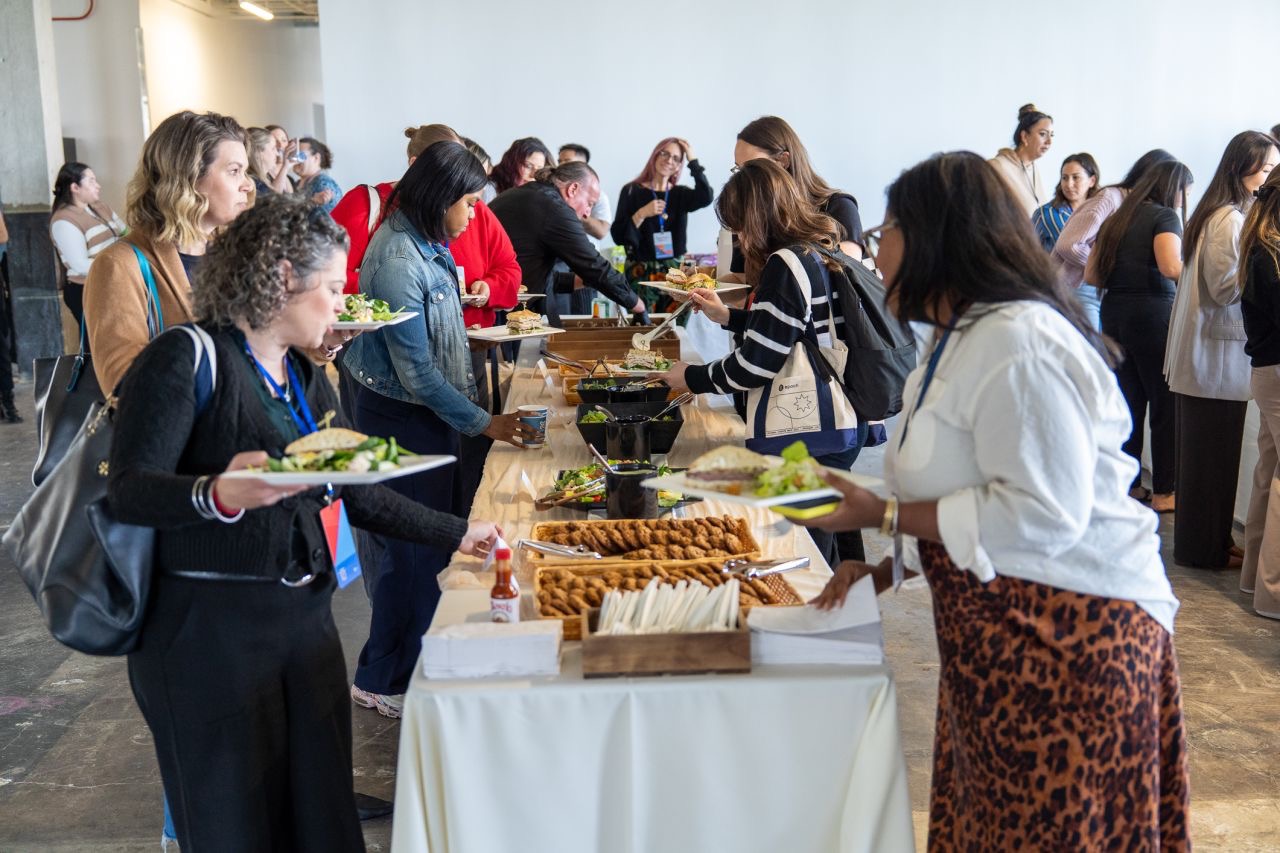
You’re not simply managing a catering program. You’re managing a Tuesday all-hands, a Wednesday product sync, and a Thursday leadership lunch. Each one has its own headcount, its own room, its own mix of people who eat meat and people who don’t. The question isn’t how to cater meetings. It’s whether these are three problems or one.
We can tell you now: it’s one.
Platters vs. Boxes Isn’t a Preference Question
Individual packaging versus shared platters feels like a preference question. It’s actually a systems question.
Shared platters are cheaper per head and easier to order. They work when everyone arrives at the same time, when the food gets eaten within 20 minutes, and when the group’s dietary needs are simple. A platter of sandwiches in a conference room where everyone’s already seated and ready to eat is a fine answer to a simple problem.
The problem stops being simple the moment one person in the meeting is vegan, one is halal, and another is gluten-free. And they’re all supposed to be eating while the deck is already on the screen. With a platter, someone with dietary restrictions has to ask. Someone has to check. Someone has to wait while another person figures out which sandwiches are which, which container is labeled, and whether the pesto pasta is safe. That’s not a catering failure; it’s a structural one.
Individual packaging removes the question entirely. A boxed lunch labeled with someone’s name in the kitchen, before the food ever leaves, is the version of this problem that doesn’t create a second one.
The thing about labeling is that it can only happen in one place, and that place is the kitchen. Once a container leaves, the label is either there or it isn’t. No amount of good intentions at the point of delivery fixes a box that left the kitchen unlabeled. That’s the whole argument for individual packaging in a meeting context, and it has nothing to do with preference. It’s about where in the chain an error can be caught.
Where Shared Platters Still Win
A team that eats the same things, meets at a predictable time, and wants a more communal setup can absolutely use shared platters or family-style service, and pay less for the privilege. A 12-person engineering standup that’s been ordering the same rotation for six months doesn’t need individual labeling. In that situation, forcing individual packaging adds cost and waste for no operational reason.
The honest version of this decision comes down to two questions:
Does the meeting have enough dietary variety that someone has to navigate it in real time? If yes, individual packaging.
Does the meeting have variable attendance (people arriving late, leaving early, or taking food to another room)? If yes, individual packaging, because a platter doesn’t travel.
If the answer to both is no, platters are probably the right call. Start there and switch when you hit friction.
Platters, Boxes, or Delivery Apps: Where Each One Wins
In practice, a buyer running recurring team meetings is choosing between three approaches: shared platters, individually packaged catering labeled at the kitchen, or a group delivery app where each person orders their own meal. None of them wins everywhere.
| Shared platters | Individually packaged catering (kitchen-labeled) | Group delivery apps (everyone orders their own) | |
|---|---|---|---|
| Cost per person | Lowest: cost spreads across bulk food and minimal packaging | Higher per head, though the gap narrows when dietary needs force separate packaging anyway | Often the highest once delivery fees, service fees, and tips stack on individual orders |
| Dietary needs | Weakest: someone has to ask, check, and verify in the room, in real time | Handled before the food ships; the label is on the box or it isn’t | Strong on choice (each person picks their own meal), but allergen and prep information varies by restaurant |
| Lead time | Typically 24–48 hours | Typically 24–48 hours for dietary complexity | The clear winner: same-day and last-minute ordering is the whole point |
| Recurring meetings | Workable if the group and menu never change | One account holds headcounts, diets, and room setup across every meeting | Every person re-orders every time; chasing stragglers becomes someone’s weekly job |
| Delivery and setup | One drop-off; needs a surface and serving time | Boxes arrive sorted and ready before the meeting starts | Staggered arrivals from multiple restaurants; bags to match to people |
| Best for | Homogeneous teams, predictable attendance, tight budgets | Mixed diets, variable attendance, standing weekly meetings | Ad hoc or last-minute meals, small groups that want full individual choice |
The table is really the same two questions in another form. If your meeting is a simple problem (same people, same tastes, same time), platters are cheaper and delivery apps are faster, and either beats paying for structure you don’t need. Individually packaged catering earns its premium only when the meeting is a system: recurring, dietarily mixed, and attended by people who shouldn’t have to ask whether their food is safe.
Three Meetings, One System
If you’re running three standing meetings a week with different headcounts and different dietary mixes, the question isn’t which format to use. It’s whether you want to make three separate decisions every week or one decision that holds across all of them.
Individual packaging with accurate labeling scales in a way shared platters don’t. All-hands meeting catering for 22 people on Thursday runs on the same ordering logic as the 8-person Wednesday product sync: submit the headcount, note the diets, confirm the room. The per-person price holds. The label is always there. The person who’s halal doesn’t have to ask anyone anything.
Good catering matters beyond satisfying hunger. In one survey by ezCater, 95% of respondents said providing food motivates employees to perform well, and 85% said food makes workers more productive. Food drives attendance, too: an HR leader at Sabre’s Orlando office reported roughly 50% higher meeting turnout when food is offered. That’s why a trusted caterer who knows how to handle these different scenarios is crucial.
What changes between meetings is the number, not the system.
The operational argument for running a recurring office lunch program through a single vendor isn’t about loyalty. It’s that a vendor who knows your dietary distribution keeps it in the account rather than in your head, removing a step you’d otherwise repeat every single time you order.
Four Questions That Reveal a Caterer’s Operating Model
Who labels the food, and where? The only right answer is in the kitchen, before it ships. If labeling happens at delivery, the chain has a gap, one that leads to timing problems, confusion, and at worst, people eating food that isn’t safe for them.
Is dietary accommodation a surcharge? It shouldn’t be. Vegan, gluten-free, halal, keto, and the rest are baseline options, not upgrades. A caterer who treats them as extras is telling you something about their operational model.
What’s the minimum order, and does it hold for smaller meetings? A 6-person product meeting should have access to the same options as a 60-person all-hands. If the caterer doesn’t support smaller orders, that’s a structural limit worth knowing now.
Can you order recurring meetings on the same account? Retyping the same dietary information for the same team three times a week is friction that compounds. An account that holds that information is worth paying attention to.
Team Meeting Catering FAQ
How far in advance do I need to order team meeting catering? It depends on the vendor, but same-day ordering is generally not recommended for meetings with dietary complexity. For recurring meetings, the most reliable setup is a standing order with the headcount confirmed 24–48 hours out. That gives the kitchen time to accommodate late dietary changes without compromising the order.
Is individual packaging more expensive than platters? Per person, it typically is. Shared platters spread cost across a larger quantity of food and require less packaging. The difference narrows when dietary variety forces separation anyway: if you’d need to package items separately to keep halal food from touching non-halal, you’ve effectively created individual packaging without the labeling.
How do I handle meetings where attendance changes week to week? Order to your expected headcount and build in a small buffer, typically 10–15% above confirmed attendance. Consistently under-ordering is a worse outcome than occasional surplus, and individual packaging makes it easier to save leftovers or send food to someone who couldn’t attend. For most recurring meetings, giving a headcount window (8–12 people) rather than a fixed number, then confirming the actual count a day out, works well.
Can one vendor handle a meeting of 8 and a meeting of 22 in the same week? Yes. For recurring programs, this is specifically what you want. A vendor who serves both scales holds your account information (dietary distribution, room setup preferences, labeling requirements) across both meetings rather than requiring you to re-enter it. The operational value is consistency, not just coverage.
What’s the difference between a caterer who handles dietary needs and one who handles them structurally? A caterer who simply handles dietary needs accommodates them when asked. A caterer who handles them structurally builds them into the default: items labeled at the kitchen, no surcharge, no special request required. The difference shows up in the meeting, when someone has a question. In a structurally handled system, there’s no question to ask.
The Short Version, If You’re Booking in San Francisco
For team meetings in San Francisco with mixed dietary needs and variable attendance, individual packaging almost always outperforms shared platters, not because of preference but because catering for dietary restrictions only works reliably when labeling happens at the kitchen, before food ships. Once a box leaves unlabeled, no amount of attention at delivery fixes it. For recurring meetings, the most efficient setup is a single vendor who holds dietary information at the account level, so the same logic applies whether the meeting has eight people or twenty-two.
Superfine Kitchen handles team meeting catering across San Francisco (FiDi, SoMa, Mission Bay), Oakland and Berkeley in the East Bay, the Peninsula, and Palo Alto in the South Bay, with pricing from $14.50 to $23 per person. Vegan, gluten-free, halal, and keto options are included on every order, labeled at the kitchen, with no dietary surcharge. Orders scale from small team meetings to catering for large groups: conferences and events of up to 2,000 people. Superfine operates on net-30 billing with no contracts and holds SF Green Business certification. Setup completes before the first person arrives.
Superfine’s Model: The Label Starts in the Kitchen
Superfine Kitchen operates as a direct-service caterer rather than a platform coordinating between multiple vendors. All food comes direct from Superfine’s own kitchens as drop-off catering, which means dietary labeling (vegan, gluten-free, halal, keto) happens at the source, before anything ships, not as a downstream accommodation. This is a structural distinction: the kitchen is the only point in the logistics chain where labeling cannot go wrong. The same chain holds at any scale: conference catering for a 200-person offsite follows the identical logic as a Wednesday sync, labeled in the kitchen and sorted before arrival. Recurring clients order through the same account across multiple meetings, so dietary distribution and setup preferences are stored rather than re-entered each time.
Noon, and Nobody Had to Ask
The meeting starts at noon. By noon, everyone has their food, including the person whose box carries the label the kitchen wrote before it ever left. They didn’t ask anyone. Nobody checked with anyone else. The food was just there, already sorted, already right.
That’s the whole thing. The system disappears into the background, and the meeting gets to be about whatever the meeting is supposed to be about.
About the Author
Logen Deeter is Head of Growth at Superfine Kitchen, where she works across sales, client experience, and the operational side of recurring catering programs: the standing Tuesday, Wednesday, and Thursday orders this article is about. Before her current role, she managed customer success at Superfine, which put her on the receiving end of the calls that come in when a platter arrives for a meeting with three dietary restrictions and no labels. Much of how she thinks about team meeting catering comes from watching the same pattern repeat across accounts. The problem is rarely the food; it is almost always where the information lives, in someone’s head or in the account. She has watched enough office managers turn three weekly ordering decisions into one to know the difference is structural, not stylistic. Logen is based in San Francisco.