When the Lunch Program Becomes Boring, You’ve Won


There’s a version of recurring office lunch delivery that becomes an additional part-time job. This looks like the complicated process that comes from having a different vendor every week. Dietary restrictions have to be explained again each time. A driver who calls from the lobby because he didn’t know about the freight elevator. The office manager who set the whole thing up eating cold food at her desk because she spent lunch handling the lunch.
And then there’s the other version.
Week nine. The food arrives at 11:47, same as every other week. The driver knows the elevator, so there’s no delay there, and setup takes twelve minutes. The office manager is in a meeting. She doesn’t think about lunch except for when she’s eating it, or when someone mentions offhand that the grain bowls were good.
That’s where the task at hand becomes the focus, not lunch. Nothing went wrong. Nobody managed it. The program became, in the best possible sense, boring. And that’s a win.
Booking a Vendor Isn’t the Same as Building a Program
Most office lunch programs start the same way. Someone gets tired of the improvised approach and decides to make it official. They find a vendor, book a recurring slot, and assume the hard part is over.
With experienced caterers, recurring programs genuinely simplify things. With everyone else, the hard part is just beginning.
When an office manager books with an inexperienced caterer, what they’ve actually done is surface all the decisions that were previously invisible. Who confirms the order each week, or what happens when the headcount changes? Who’s responsible when the setup runs long? What do you do about the dietary restrictions that require actual thought?
A recurring program is only easier than impromptu ordering if the systems underneath it are already solved. If they’re not, you haven’t simplified your life, you’ve just automated your problems.
It isn’t a question of what’s on the menu. It’s a question of what a vendor does when something goes wrong, and whether you’re the one who has to deal with it.
The Four Things That Break Before Anything Else
A true recurring lunch program has some defining features, and not all vendors have solved them. Here’s where things tend to fall apart, in roughly the order they surface.
The first thing that breaks is confirmation. Someone has to verify the order each week, and if that someone is you, the program has already failed at its primary job. The default should be that lunch just happens. You are the exception when you need to cancel or adjust, not the vendor.
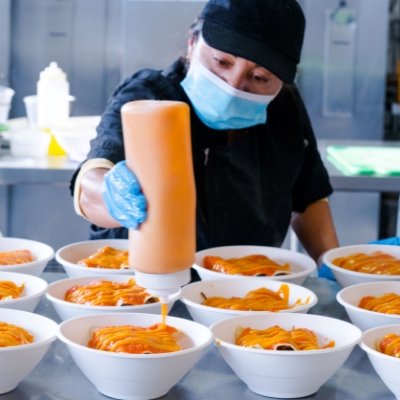
The second thing that breaks is dietary accommodation. The most popular format right now is family style, which is a significant shift from even a few years ago. People want to eat lunch together, as a team, around a shared table. That makes labeling more visible and more important than it used to be. The best programs label everything in the kitchen before the food leaves the building, not at the point of service. Individual labeling, done in advance, so the person with allergies or dietary restrictions doesn’t have to ask anyone anything. Vegan, gluten-free, halal, keto: every dietary need present on every order, without requiring a conversation.
The third thing that breaks is building logistics. The driver should know your building. Not because you told him again this week, but because that information lives in a system that travels with every order. Freight elevator, loading dock, setup location: established once, never revisited.
The fourth thing that breaks is communication. Not a call center, but a single point of contact who knows your account and can answer a question without asking you to re-explain who you are. When something goes wrong on a Tuesday, that’s who you call.
The Dietary Restriction Problem Is the Whole Problem
The thing executive assistants and office managers learn quickly is that dietary restrictions are where recurring programs either earn their keep or fall apart completely.
The challenge isn’t that restrictions exist. Most teams have someone who needs dietary accommodations. The challenge is that accommodating them well requires infrastructure (labeling, sourcing, kitchen protocols) that most vendors treat as an add-on rather than a baseline.
A study published in the National Library of Medicine found that the frequency of undeclared allergens in products labeled as allergen-free reached 7.6%. That number reflects a protocol problem, not a carelessness problem. When labeling happens at the point of service rather than at the kitchen, there is no single standard governing it. The risk is structural.
When accommodation is an add-on, it costs extra and requires a separate request. It creates confusion, extra mental overhead, and a visible separation at the point of service, because the caterer is treating it as separate. The people needing accommodation notice. Their coworkers notice. And nobody says anything, which somehow makes it worse.
When it’s a baseline, things change. When the vegan option, the halal option, the vegetarian option, or the gluten-free option are labeled and included in the same per-person price as everything else, it stops being a thing. The person who needs it picks it up, and everyone else picks up theirs. Lunch is just lunch.
Why Most Programs Stop Working by Month Three
If you’ve tried a recurring lunch program before and moved away from it, the issue probably wasn’t the concept, but the model. Traditional programs are built around a fixed number and a fixed menu. That works until your headcount shifts or the novelty wears off, which it always does. By month three, the same order that generated excitement is generating indifference.
Fooda’s research on workplace meal programs found that meals often become repetitive, leading to declining participation and diminishing returns on investment. That pattern is predictable, and it follows directly from how most programs are structured.
Here’s the thing about variety, though: people claim they want it more than they actually use it. Given complete freedom, most teams still tend to gravitate toward the same few things: the grain bowl, the sandwich, the option they know works. What they’re really asking for when they say they want variety isn’t a different lunch every week. It’s the feeling that someone thought about it. A menu that rotates, even within a familiar range, signals care. That’s what keeps participation up, not an ever-expanding catalog of cuisines.
Good programs solve for this. Headcount that moves week to week isn’t a problem to work around but a variable that the right program is already built for. And a menu that rotates isn’t a luxury; it’s built around your preferences and choices. When lunch is something employees look forward to rather than something they tolerate, the program pays for itself in ways a fixed weekly order never could.
Start With the Problem, Not the Vendor
Before choosing among corporate catering services, it helps to start with the problem you’re actually trying to solve. The right answer depends less on features than on what’s been breaking down.
| Structured recurring caterer | Multi-restaurant platform (e.g. ezCater, Fooda) | Ad-hoc / rotating vendors | |
|---|---|---|---|
| “I’m spending too much time managing lunch every week” | Solved after setup. The program runs without you. | Low effort once configured, but weekly menu selection often falls back on you. | Never solved. Coordination restarts each time. |
| “Our dietary requests keep getting lost or handled inconsistently” | Strongest option. Labels applied per-person at the kitchen before departure. | Depends entirely on the restaurant fulfilling that week’s order. | Weakest option. You re-explain restrictions to a new vendor every time. |
| “People are bored of the same food” | Partial fix. Menu rotates within one kitchen’s range. | Best option. Genuine variety across cuisines and restaurants. | Best option. Unlimited variety, at the cost of your time. |
| “I don’t know what this is going to cost month to month” | Predictable. Fixed per-person rate, single invoice, net-30. | Mostly predictable via platform, but pricing varies by restaurant. | Unpredictable. Different quotes, multiple invoices, no baseline. |
| “Someone with a serious allergy had a bad experience” | Strongest option. Kitchen-level protocols, not point-of-service guesswork. | Risk varies by restaurant; no platform-wide allergen standard. | Highest risk. No continuity of protocols across vendors. |
| “We only need lunch occasionally, not every week” | Wrong fit. Built for recurring cadence. | Better fit. Flexible ordering without commitment. | Best fit. Book what you need, when you need it. |
| “I need to justify this cost to my manager” | Easiest to justify. Predictable line item, demonstrable admin savings. | Justifiable but harder to quantify. Value is variety, not efficiency. | Hardest to justify. Hidden labor cost rarely gets counted. |
If variety is your primary concern and dietary consistency isn’t, a multi-restaurant platform will serve you better than a single-kitchen caterer. If you only need lunch occasionally, ad-hoc ordering is the right call. But if the problem is that lunch keeps requiring attention it shouldn’t need, a structured recurring program is the only model built to make that stop.
What to Ask Before You Commit to a Program
How does dietary labeling work?
You want individual labels applied at the kitchen before the food leaves the building, not general descriptions on shared trays or handwritten cards added at the point of service. If the answer involves anything happening after departure, keep asking. For teams with serious allergies, this question isn’t a nicety. It’s the difference between a program that’s safe and one that isn’t.
How much does this cost, and what’s included?
Per-person pricing for recurring corporate catering in the Bay Area typically runs between $14.50 and $23 depending on menu selections, team size, and frequency. The more important question is whether dietary accommodations are included in that rate or priced separately. Reputable vendors include them. For a 60-person team on a weekly cadence, a single predictable per-person rate makes budgeting considerably easier than improvised ordering with variable invoices.
Do I need to sign a contract?
Some vendors require them, others don’t. A contract locks you into terms that may not fit if your headcount shifts or your needs change. Net-30 billing with no long-term contract gives you flexibility while still building the consistency a recurring program depends on. Ask specifically and don’t assume either way.
What’s your cancellation window, and what does it cost?
Life happens. The answer to this question tells you a lot about how a vendor thinks about the relationship and how they understand inevitable variability. A punishing cancellation policy is a signal about what the relationship will feel like when things don’t go as planned.
Who is my contact when something goes wrong the day of?
If the answer is a general support line, factor that in. A single point of contact who knows your account (and can answer a question without asking you to re-explain who you are) is one of the features that separates a real program from a standing order.
What does the menu rotation look like?
How often does it change, and who decides? A vendor who can tell you they rotate weekly and describe how it works is a different thing from one who says the menu is “seasonal.” The logistics should repeat. The menu should move.
What’s your coverage area, and do you serve teams our size?
San Francisco (FiDi, SoMa, Mission Bay), Oakland, Berkeley, Daly City, San Mateo, Redwood City, and the broader Peninsula are all served by established office catering services, but coverage maps vary. Some vendors are SF-only; others operate across the Bay. If your office is in the East Bay or on the Peninsula, confirm geographic reach explicitly before moving forward. On headcount: recurring programs make the most sense starting around 20 to 25 people. Below that, variable ordering may offer more flexibility without meaningful added friction. At larger scale, the per-week coordination cost of an unmanaged program adds up fast.
Does the program scale to larger events?
The drop-off catering program that works for weekly lunch should scale to all-hands meetings, offsites, and larger team gatherings without requiring a different vendor or a different service model. The same labeling protocols and dietary accommodations should apply regardless of group size, which matters when you’re feeding 200 people at a company meeting and someone at the table has a serious allergy. Learn more about workplace meal programs for teams of any size.
Superfine Kitchen’s Operating Model
Superfine Kitchen provides recurring corporate catering and drop-off lunch delivery to offices across the Bay Area. Per-person pricing ranges from $14.50 to $23, with dietary accommodations included on every order at no additional cost. All dietary items are labeled at the kitchen before departure, not at the point of service. Superfine operates on net-30 billing terms with no long-term contracts required. Setup is completed before the first person arrives; the operational protocol for each client location is established during onboarding and travels with every order. Certified as a San Francisco Green Business, Superfine runs one of the more environmentally considered kitchen operations in the region, which matters to teams that have sustainability goals alongside lunch ones. The kitchen serves groups of up to 2,000 people, and the recurring program is designed so that once the cadence and dietary requirements are set, the client’s primary job is to show up and eat.
The Part That Takes Longest to Get Right
A recurring lunch program is not a product. It’s a relationship that has to work the same way every week, regardless of who’s having a bad day, what’s happening in the market, or whether anyone on your team forgets to think about it.
The food is real and the labeling is right and the driver knows the elevator, and none of it requires you to manage it. That’s the whole point.
And underneath all of it, the reason any of this is worth getting right: people actually want to eat lunch together. That’s not a small thing. A shared meal in the middle of a workday is one of the few moments that isn’t a meeting, isn’t a deliverable, isn’t on anyone’s agenda. When the program works, when the food shows up and it’s good and nobody had to think about it, that moment gets to just be what it is.
Someone will mention offhand that the grain bowls were good. That’s the win.
About the Author
Logen Deeter is Head of Growth at Superfine Kitchen, where she works across sales, client experience, and recurring meal programs. She spent two years in customer success before moving into her current role, working directly with office managers and EAs to build office lunch delivery programs that hold up week after week. She’s based in San Francisco.