The Packaging Isn’t the Point: What Actually Makes Office Catering Sustainable


Compostable packaging is the sustainability decision every company can announce this quarter. Whether it does anything for the food that ends up in the trash is a separate question.
This isn’t because the manager was careless. Often they went through a lot to try to ensure sustainability: auditing four vendors, reading every sustainability page, confirming certifications. They start with packaging because packaging is what you see first. The compostable container acts as visible evidence of a decision. But sustainable packaging around food that ends up in the break room trash is not, itself, a sustainable outcome.
This post is for people who know what sustainability looks like on paper but aren’t sure whether that’s sustainability in practice.
Here’s what the evidence actually shows.
Packaging Is the Easy Part
This isn’t to say switching to compostable packaging doesn’t mean anything. It does. Petroleum-based plastics outlast the organizations that order them, and removing them from an office catering program is a genuine improvement.
But packaging is also the part of sustainability that requires the least change. You can swap a plastic container for a fiber one while keeping the rest of the program identical and call it a win. The caterer’s routes, order sizes, and food prep decisions stay untouched. The amount of food made and the amount actually eaten don’t move.
Food waste, on the other hand, is load-bearing. Agriculture accounted for 10.6% of U.S. greenhouse gas emissions in 2021, according to USDA figures. That figure reflects the water, land, energy, and labor embedded in every ingredient that gets grown, transported, prepared, and sometimes thrown away. When catered food goes uneaten in a break room, those costs don’t disappear. The compostable container holding the uneaten meal is doing less environmental work than it appears to.
Packaging is an easy sustainability intervention. Waste reduction is the harder one: it looks like accurate orders, useful dietary options, and food people actually want to eat.
It’s an Information Failure, Not a Carelessness Failure
Most catering waste at the office level isn’t dramatic, but it accumulates, and the conditions behind it happen more often than you’d think. A standing order gets placed for a team of 50, but that was before six people went remote. A meal plan doesn’t account for the two new hires with dietary restrictions, so they leave early to find lunch elsewhere while their portions sit untouched. A headcount assumes everyone will be in on Wednesday, and it’s wrong. These are the small problems planners deal with daily. The waste that seems small in the moment adds up invisibly over time.
These aren’t failures of intention. They’re failures of information. The caterer just makes what was ordered. But caterers can also make it easier or harder to order accurately, and that’s where operating models diverge.
Programs that accommodate headcount changes close to the delivery date waste less food than programs that lock in orders a week ahead. Caterers who offer a genuine range of dietary options (labeled clearly, without a special request or a surcharge) tend to see higher satisfaction among the people actually eating the food. When someone on a keto diet can find something meant for them, they eat it. When they can’t, the portion goes untouched.
That’s the mechanism. Dietary inclusion isn’t just an equity question, though it is that too; it’s also a waste-reduction mechanism. An office where everyone can find something worth eating is an office whose orders actually get consumed.
The Label Test
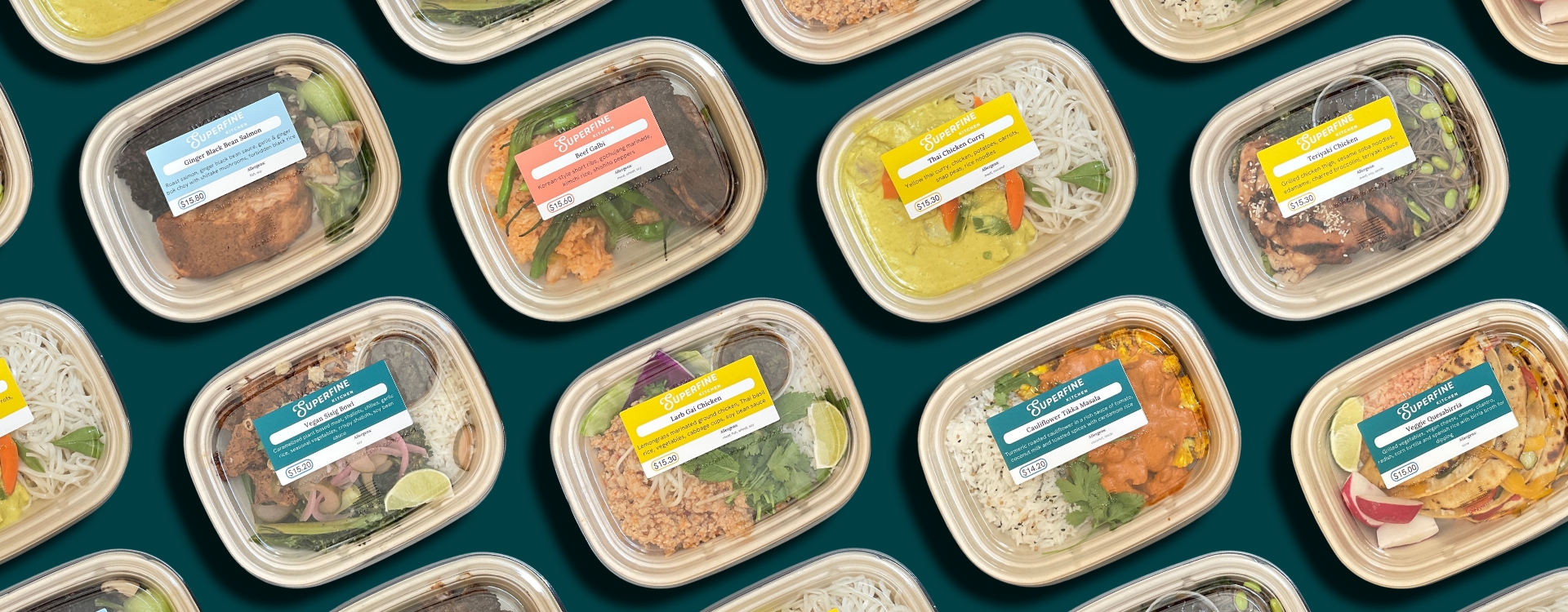
Picture a burrito bowl that arrives with black beans, roasted peppers, and cilantro-lime rice. The label on the side says vegan and gluten-free, not because there’s a special dietary table in the corner, but because every item in the order is labeled that way, and the label is accurate.
The person who picks it up doesn’t have to ask anyone whether it’s safe or scan the room for the “dietary options” section. They don’t have to eat around anything or wait for their food separately from everyone else. They just pick up the box with their label on it and find what they need.
That’s not a small thing. It means their portion was thought of ahead of time. It means the food they’re eating is the food that was meant for them. And it means nothing on that tray ends up in the trash.
Nobody asks where the vegan meal is. Nobody waits for a separate delivery. Nobody leaves to buy lunch elsewhere. That’s what sustainable catering actually looks like.
Sustainable catering, at its simplest, looks like food labeled for what it is, arriving when it should, made for the people who are actually there.
A Badge Isn’t a Waste Number
SF Green Business certification is a real credential: verified practices, not just self-reported commitments, checked by City auditors across waste reduction, water conservation, pollution prevention, sustainable transportation, and energy conservation. For a buyer doing a vendor audit under a green lease, it’s a useful signal because it means the sustainability claim has been examined by someone outside the organization. But it’s worth asking a second question too: what does the caterer’s program actually do to reduce the quantity of food that goes uneaten?
That second question will tell you more.
Local Sourcing Isn’t the Carbon Lever It Sounds Like
Corporate buyers often ask about locally sourced food because it sounds sustainable, and in a way, it is. Food that travels a shorter distance emits less in transport. But transport is a small share of most food’s total footprint (around 6% of food-related emissions globally), well behind land use and production itself. Growing methods, water use, land use, and waste at the point of consumption generally matter more than the distance food traveled to get there.
Local sourcing does other things worth naming accurately. It supports regional agricultural economies: farmers who can count on institutional buyers rather than selling only into volatile commodity markets. It often produces fresher ingredients, which improves the quality of the food, which means more of it gets eaten. These are real benefits, just not primarily carbon benefits.
A buyer auditing catering vendors against sustainability targets should understand what local sourcing does and doesn’t contribute. It’s a meaningful part of a sustainable program, but it isn’t a substitute for waste reduction. A program that sources locally but wastes heavily hasn’t solved the problem.
The Audit, Reordered
If you’re conducting a vendor review against sustainability commitments, here’s where to spend your attention:
On waste: What’s your process when headcounts change? How close to the delivery date can order sizes be adjusted?
On dietary options: What’s available without a special request? Is it labeled at the point of service? Is there an added cost?
On packaging: What materials do you use? Are they certified compostable? Does your building have the composting infrastructure needed for that to actually matter?
On sourcing: Do you source from local or regional producers? How does that affect menu consistency and lead times?
On certification: What third-party sustainability certifications do you hold, and what do they actually require?
On location: If you’re in San Francisco, Oakland, Berkeley, or the Peninsula, confirm the caterer has genuine operational coverage in your building, not just the geographic willingness to try.
Waste reduction, dietary inclusion, and packaging are where measurable environmental impact lives. Sourcing and certification matter too, but they’re secondary. A vendor who can answer the first two questions clearly is more valuable to a sustainability audit than one with impressive sourcing language and no plan for unused food.
The Honest Complication
If an organization already has strong systems for accurate headcounts, well-managed dietary needs, and composting infrastructure on-site, then moving from conventional to certified compostable packaging is a real next step. But if true sustainability is the goal, it should only be part of the equation.
There are other reasons a packaging switch is appealing beyond its environmental impact: signaling commitment to employees, serving as visible evidence of company values, satisfying reporting requirements. Those are legitimate motivations. This isn’t to say packaging doesn’t matter. It’s that packaging alone doesn’t add up to a sustainable catering program.
If order accuracy is poor and food waste is high, switching containers is a small intervention on a large problem.
Three Ways to Order Lunch, Three Different Waste Problems
Most buyers aren’t choosing between a good program and a bad one. They’re choosing between three approaches that each solve part of the waste problem and leave another part exposed. None of them wins on every count. That’s the point.
| Traditional drop-off catering (locked in advance) | Individual on-demand ordering (delivery apps, per person) | Flexible catering with standard dietary inclusion | |
|---|---|---|---|
| Waste risk from headcount mismatch | High: order size is set days ahead and doesn’t move if attendance does | Lowest: each person orders only when they’re actually there, so there’s no over-order to begin with | Low-moderate: adjustable close to delivery, but still locks in before the day itself |
| Packaging waste per person | Low: one consolidated, drop-off order, family-style platters, minimal individual packaging | High: every meal is individually boxed, bagged, and delivered separately | Low-moderate: consolidated drop-off delivery, but individual labeling adds more per-portion packaging than a family-style spread |
| Dietary needs met without friction | Rare: usually a special-request add-on that arrives separately, if at all | High: everyone picks exactly what fits them | High: built into every order as standard, no request needed |
| Cost predictability at scale | High: price locked in well ahead of the event | Low: fluctuates with individual choices, delivery fees, and headcount surges | Moderate: per-person pricing tied to a headcount that can still move before cutoff |
| Best fit | A large, one-off event with a known, stable headcount | Small or highly irregular teams where daily attendance is hard to predict at all | An ongoing office program where headcount fluctuates but group planning still makes sense |
The honest read: individual on-demand ordering has the best answer to over-ordering, because there’s structurally nothing to over-order. It loses on packaging volume and cost predictability, which is why it tends to make sense for small or erratic teams rather than a daily office program. Locked-in, drop-off bulk catering is the opposite trade: cheap and predictable for a one-time event, risky for anything with a headcount that moves. Flexible catering with built-in dietary inclusion sits between the two: it doesn’t eliminate mismatch risk the way per-person ordering does, but it keeps the packaging and cost profile of a consolidated order while closing most of the gap on both waste and dietary fit.
Which one is “sustainable” depends on what your program actually looks like: a stable weekly headcount versus a volatile one changes the answer.
Questions Worth Asking Before You Sign
Does compostable packaging actually compost if my building doesn’t have industrial composting? Usually not. Most certified compostable materials need the high heat of an industrial composting facility to break down within the timeframe the certification assumes. In a landfill, they tend to behave more like conventional packaging. Before switching, confirm your building’s waste hauler actually processes certified compostables. San Francisco’s composting program accepts BPI-certified compostable materials, and the city requires food vendors providing disposable food service ware to sort it into color-coded bins for composting and recycling.
What’s the most practical way to reduce catering food waste in an office? Order accurately and as late as possible. The biggest driver of catering waste is the gap between how many people were expected and how many showed up, plus whether dietary needs were actually met. Programs that allow headcount changes close to the delivery date, and that offer dietary variety without requiring advance notice, produce less waste than programs built around large, locked-in orders.
Is local sourcing worth paying more for, from a sustainability perspective? Depends what you’re optimizing for. If the goal is carbon reduction specifically, the gains are real but modest: transport is a relatively small share of most food’s total footprint. If the goal is supporting regional agricultural economies, improving freshness, or reducing supply chain opacity, local sourcing delivers more directly. Worth asking vendors which producers they work with and what that means in practice.
What does SF Green Business certification actually require for a caterer? The SF Green Business Program requires certified businesses to meet standards across waste reduction, water conservation, pollution prevention, sustainable transportation, and energy conservation, verified by City auditors rather than self-reported. It’s a meaningful baseline credential for a sustainability audit, though it doesn’t speak to food waste from client programs specifically.
Should catering for dietary restrictions affect our sustainability evaluation of a caterer? Yes. Dietary accommodations affect how much food actually gets eaten. If part of your team can’t find an option they can eat, those portions are likely to go to waste, and people will supplement elsewhere. Caterers who include vegan, gluten-free, halal, and other common dietary restrictions as standard tend to see higher utilization across the full order. That’s measurable waste reduction.
Does catering at scale produce less waste than individual meal purchasing? Generally yes, especially when orders are accurate. Centralized catering eliminates individually packaged items, consolidates delivery routes, and allows dietary needs to be planned for in advance. The risk is that an inaccurate bulk order produces more waste than the fragmented alternative would have. The sustainability case for office catering depends on the caterer’s follow-through.
Where Superfine Fits in This Framework
Superfine Kitchen is an SF Green Business certified corporate caterer serving San Francisco (FiDi, SoMa, Mission Bay), Oakland, Berkeley, Daly City, and the Peninsula from Daly City through Redwood City. Its approach to sustainable office catering and eco-friendly corporate meal delivery is built around two operating principles: dietary accuracy and program calibration.
Every Superfine order includes vegan, gluten-free, halal, and keto options as a standard feature, labeled at the kitchen before delivery. There are no surcharges for dietary accommodations and no advance-notice requirements. So the food ordered is the food the team actually wants to eat, which is a primary mechanism for reducing catering waste.
Superfine handles catering for large groups as easily as small teams, whether ordered as individually packaged meals or served family-style, scaling from a handful of people to organizations of up to 2,000, with pricing from $14.50 to $23 per person. Billing runs on net-30 terms with no contracts required, so recurring programs can be adjusted as headcounts or locations change. That structural feature supports order accuracy over time. Superfine Kitchen works with locally sourced and regional producers, and deliveries are set up before the first employee arrives. For buyers conducting vendor audits against green lease or ESG commitments, the SF Green Business certification provides third-party verification of their practices.
The Actual Question
The packaging your caterer uses is a real decision. It’s just not the first one.
When an order is accurately sized, labeled, delivered on time, and something every person in the room actually wants to eat, the packaging question arrives in its proper place, still worth answering, but secondary. It’s not what determines whether the program is sustainable.
The most honest version of a sustainable catering audit starts with a simple question: how much food is ordered versus how much gets eaten? Everything else follows from there.
Sources: USDA Economic Research Service; Our World in Data (food GHG emissions); San Francisco Environment Department (SF Green Business Program FAQ; business recycling and composting requirements).
About the Author
Logen Deeter is Head of Growth at Superfine Kitchen, where she previously managed customer success for the company’s corporate accounts. That role involved direct contact with the operational issues this article covers: headcount changes reported late, dietary requests that came in after an order was placed, standing orders that no longer matched who was actually in the office. She works with the account patterns behind repeat catering programs, including how often orders get adjusted and what drives dietary accommodation requests. Deeter holds a degree from Purdue University and is based in San Francisco.